

Hello to Canada’s SaaS and AI Community,
Growth still looks the same on the surface; revenue climbs, teams expand and momentum builds.
But underneath, the rules have changed and what once passed as progress is now being tested more closely, by investors, by boards, and increasingly by the business itself.
In a recent conversation, Susan Richards, CEO of Numbercrunch, shared what she’s seeing across the companies she works with and where financial discipline is becoming the difference between companies that scale with control and those that quietly lose it.
What emerged wasn’t a new idea but a clearer view of something many founders already sense: growth without financial clarity doesn’t hold for long.
Key takeaways:
- Sustainable growth depends on understanding the relationship between cost, revenue quality, and timing.
- Financial discipline is built through consistent habits, not occasional attention.
- Investors are placing more weight on clarity and model integrity than narrative.
- Strong financial leadership helps companies make decisions before problems become urgent.

When Growth Outpaces Understanding
One of the first places this pattern shows up is in how companies scale their teams.
“They underestimate cost structure, their operating leverage,” Susan explained. “So, what we tend to see is that the headcount scaling is faster than the revenue and specifically the quality of revenue.”
It’s an easy trap to fall into. Hiring feels like progress, expanding the team creates momentum and it starts to signal ambition. But when that growth isn’t anchored to how revenue is actually being generated and collected, the imbalance starts to widen.
Margins tighten, cash burn accelerates and the business becomes more complex before it becomes more stable.
From the outside, things can still look like they’re working. Internally, the room for error begins to shrink.

The Work Most Founders Avoid
What separates the companies that navigate this well isn’t necessarily access to better data or more sophisticated tools.
More often, it comes down to whether founders are willing to engage consistently with the financial side of the business.
“It certainly comes down to… financial literacy and the dedication to the financial hygiene,” Susan said. “It’s the most unsexy area of a business.”
This is the work that rarely gets prioritized when there are customers to win, products to ship and teams to build. It’s easy to defer, easy to revisit later, easy to assume it will sort itself out as the company grows.
But the companies that scale predictably tend to do the opposite.
They know their unit economics. They review their financials with intention. They keep forecasts updated and adjust based on what’s actually happening, not what they hoped would happen.
“When the business owners don’t know their unit economics cold… that’s where you start to see the difference,” Susan added.
Over time, those habits compound in the same way revenue does.
The Habits That Change The Trajectory
For all the complexity around scaling, Susan kept coming back to a small set of behaviours that show up consistently in companies that stay in control.
They aren’t complicated, but they are practiced with discipline.
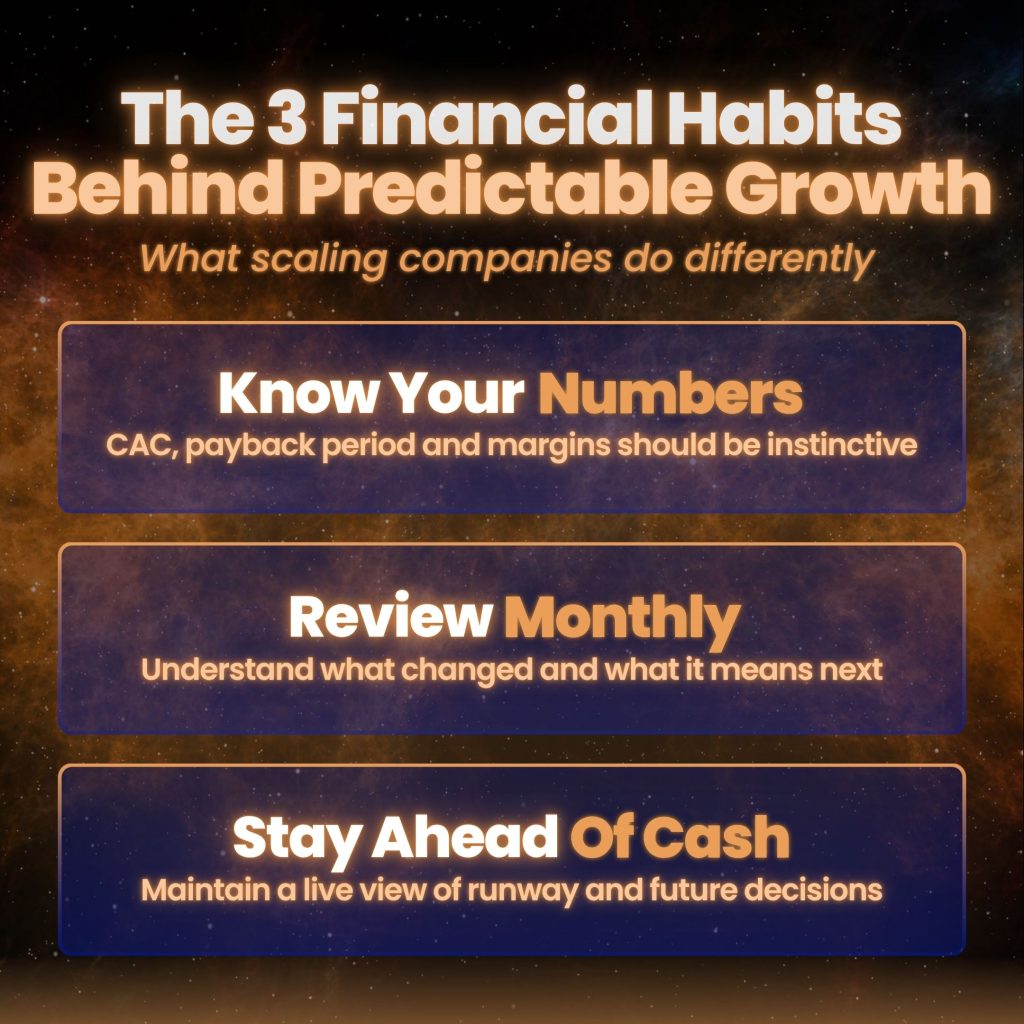
These are the kinds of habits Susan and her team at Numbercrunch help companies build early, before the stakes get higher.
When they’re in place, financial discipline stops being reactive and becomes part of how the company operates day to day.
A Different Kind of Investor Conversation
The expectations founders are meeting today aren’t the same ones that shaped the previous cycle.
“Capital efficiency beats vanity growth. So, revenue quality matters more than revenue speed,” Susan said.
That shift is changing the tone of investor conversations in subtle but important ways.
There’s less appetite for broad narratives about market size and future potential, and more focus on how the business operates today.
“At this point, investors are backing discipline. The story that used to carry a raise now comes second to the model.”
For founders, this often shows up as a different kind of pressure.
Not just to grow, but to show how that growth holds up over time, shifting the focus from projecting confidence to demonstrating real control.

Seeing Around Corners
As that pressure increases, the role of financial leadership has started to change shape.
“The CFO must be a copilot looking forward and helping the organisation navigate,” Susan said.
The expectation is no longer simply to report what’s already happened. It’s to help the company understand what is likely to happen next and how different decisions will shape that outcome.
That requires a level of honesty that isn’t always comfortable in the moment.
“The CFO has got to be the one bringing truth into the business” and sometimes, that truth challenges the direction the business wants to take.
“Being willing to be respected and challenge the CEO rather than likeable in the moment is important.”
In companies where that relationship works, decisions tend to happen earlier, with more context and less urgency.
The Value of Knowing
For founders, all of this ultimately comes back to one thing: visibility. Without it, optionality disappears.
“We want optionality,” Susan said.
Optionality to decide when to raise, when to invest, when to slow down or accelerate.
Without a clear understanding of the numbers, those decisions become reactive. With it, they become deliberate.
“Knowing the numbers allows founders to be able to stand up to challenges… and potentially to attract new investors as well.”
That shift, from reacting to deciding, is where financial discipline starts to feel less like a burden and more like leverage.
Why This Conversation Matters
What makes Susan’s perspective resonate is how familiar these patterns feel.
They’re not edge cases. They’re the quiet realities inside many growing companies, and in a market where capital is more selective and expectations are higher, those realities have become harder to ignore.
Financial clarity doesn’t guarantee success but the absence of it makes everything else more difficult.
SAAS NORTH is Canada’s hub for scaling SaaS and AI companies. Founders, teams, and investors come to learn, connect, and grow with the country’s largest in-person tech community.